Thursday, May 19, 2011

Rehab's Pretty Patient- the Pileated Woodpecker

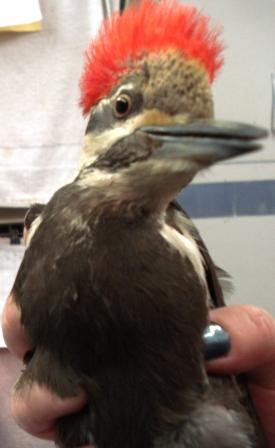
Our Wildlife Education & Rehabilitation Program has a fascinating and beautiful avian patient in treatment this week—a pileated woodpecker that suffered head trauma, most likely after flying into a window.

Pileated woodpeckers are similar in size to a crow and are the largest woodpeckers found in the majority of North America. The call of the pileated woodpecker has a loud and resonant “kuk-kuk-kuk” sound. Listen to their call by clicking here.

These birds also have a distinctive red crest on their heads and live in deciduous and coniferous forests with large trees, which they prefer for nesting. The pileated woodpecker will create a nesting cavity in a dead tree and empty it completely except for wood shavings.

Pileated woodpeckers also engage in an unusual behavior in searching for food. They dig rectangular holes in trees to search for ants. Sometimes, when digging holes in small trees, they create holes so deep that the tree may actually break in half!

The pileated woodpecker population encountered a large decline with the clearing of eastern forests, but their numbers have been making a comeback since the mid-20th century. They are not considered to be a species of concern.

If you see a bird or other animal that you believe to be injured, or if you have backyard wildlife questions, please contact Lake Erie Nature & Science Center at (440) 871-2900.

Abandoned Fawn?

Our Wildlife Education & Rehabilitation Program staffers are receiving their first calls of the year about potentially abandoned fawns. We field a ton of calls during the spring from concerned wildlife lovers, asking if a fawn lying down alone is orphaned.
Our answer? The fawn usually is NOT abandoned, but rather following its instincts. In order to protect her young, mom will frequently leave her fawn alone to prevent attracting predators to her vulnerable baby. She will return when she feels it is safe to do so. However, if a fawn is consistently walking around and making noise, there may be cause for concern.
You’ll find much more information about fawns by reading Lake Erie Nature & Science Center’s Wildlife FAQ #13 on baby deer.

The fawn is born with very little scent and white spots for camouflage. As long as the fawn does not move, it will be hidden from all kinds of danger.


Monday, May 16, 2011

Birds on the Road to Recovery in Rehab

Our Wildlife Education & Rehabilitation Program is just starting the busy season right now, so it can be difficult to pause long enough to share cool animal photos and stories. We did manage to photograph three current avian patients during treatment this week.

The first is a female Rose-breasted Grosbeak with an injured leg. Grosbeaks live in any type of woods, and have a very distinctive song that is said to sound similar to that of a robin, but more melodic, as if it were sung by an opera singer. The Center also has a male Rose-breasted Grosbeak. Click here to see the differences between the male and female Grosbeaks and to hear their song.


We also have a female Belted Kingfisher that is being treated for a fractured clavicle(collar bone). Unlike most bird species, the female Belted Kingfishers are more colorful than males, with a rust-colored band on their breast. Kingfishers are known for having a large head and bill for their small body size, which allows them to easily catch fish. They can even dive at 25 mph from great heights while hunting! The Belted Kingfisher can live in any area where there is an open body of water.


Another bird currently in treatment for a wing injury is a baby Rock Pigeon. Although many people often see pigeons as “dirty city birds”, humans have valued them for thousands of years for many reasons including as food and to carry messages. Their natural environment is rocky cliffs in the mountains and coasts of Europe. They are highly adaptable often utilizing man-made structures such as bridges and buildings for nesting which has allowed them to establish healthy populations worldwide.

The rescuer of the baby Rock Pigeon is actively searching to find the roost site in the hope that we can return the baby to its nesting family following treatment. Wild baby animals belong in the wild to learn from their parents. Please do not approach a baby animal unless it has been seriously injured.

Oftentimes baby animals may appear to be abandoned, when in fact the parents are staying away to protect them. A baby animal’s best chance of survival is to remain in the wild where their mother can care for them. If you have questions regarding a wild animal, please call Lake Erie Nature & Science Center at (440) 871-2900.

Thursday, May 5, 2011

Honeybee Hive Buzzes to Life - Watch Videos

 Lake Erie Nature & Science Center's honeybee hive is buzzing with activity again! Lorain County beekeeper Scott Danniger set up the new observation hive with approximately 3,000 busy bees today.

This larger hive has more trays (20), room and ventilation than our former observation hive which lost its queen and bees over the winter.


The queen bee (center)  is marked with a white dot.

The queen of these gentle, Italian honeybees is marked with a white spot on her back and she's already laying eggs. Stop in and try to find her in the Stickney Honeybee Exhibit. We're open 10 a.m. to 5 p.m. seven days a week and admission is free!

We have a some great still photos of the transfer posted on our Facebook page.

For more information on beekeeping, check out the website of the Lorain County Beekeepers Association. They make educational appearances and hold a series of classes, if you're interested in learning more about raising honeybees.

Wednesday, April 27, 2011

Fox Family Shares NE Ohio Home

One of our great Wildlife Education & Rehabilitation volunteers has a front row view of spring baby season and was kind enough to share her photos with us! A Red Fox has created a den under the her deck and, at this time of year, the kits are starting to explore with the parents.

Wildlife Rehabiltiation Coordinator Amy LeMonds says that it's not uncommon to see a fox family out during the day while the kits are in this learning stage of life, even though these animals are typically nocturnal. We estimate that the kits in the photos are probably a couple months old.

Our volunteer reports that mom is an excellent hunter and is observed providing animals to the kits daily. The youngsters will soon become more successful hunting on their own but stay with their family for up to 9 months.

You never know who or what will wind up sharing your backyard (or deck, if you let them) in Northeast Ohio. We're not disclosing the location of our volunteer's home to make sure both the human and fox families maintain privacy.


Tuesday, April 26, 2011

Student Rainbarrel Project

Lilly Lowther, Danielle Gaudino
and Katherine Knight pose 
with the rain barrel and Center
Executive Director Catherine Timko.
Just in time for Earth Day last week, students in Mrs. Martha Fisher’s third grade class from Westerly Elementary School in Bay Village dropped off a rain barrel, beautifully painted with flowers and insects. Lake Erie Nature & Science Center is one of several locations around town displaying the students' handiwork, complete with an educatonal message about the benefits of rain barrels (like reduction of erosion, pollution and flooding).

The class is selling each rain barrel  for $100 with the proceeds going to the Bay Education Foundation. If you're interested in buying a decorated rain barrel you can contact Mrs. Fishers class at 440-617-7578. Nice work students and thanks for sharing your work with our visitors!

Wednesday, April 20, 2011

List of Duck Prizes and Sponsors Growing

Do you have a duck in the race yet? The list of Family Fun Fest and Great Duck Race sponsors and prize donors is growing. Cash, sports tickets, museum and zoo passes, certificates for tasty dining and more are already on the list of cool stuff that will make up the prize packs given to first 30 ducks to cross the finish line on Porter Creek.

So far, four generous area businesses have stepped up to sponsor this year's event! Join us in recognizing Faber-Castell/Creativity for Kids, The Goddard School for Early Childhood Development, Hyland Software and ShurTech Brands!

Want to join our sponsors or prize donors? There's still time leading up to our Sunday, June 5 event. Call 440-871-2900 today and ask for Ann Miller or Barb Caskey.

Access a Fun Fest Duck Sponsor form here.

Thursday, April 7, 2011

Nature & Nesting Ducks Know Best

We're heading into Mallard nesting season and each year, we expect this question on the other end of our frequently ringing Wildlife Education & Rehabilitation phone line: "A duck started a nest in my yard and laid a couple of eggs, but she's not sitting on the nest! What should I do?"

This common question can best be answered through an explanation of how Mallards nest. The female mallard (hen) will spend weeks scouting out an area to build her nest. Mallards will nest almost anywhere within reasonable distance of a water source and often in what seems to be inappropriate locations such as near a road, in a parking lot or a yard with big dogs. It’s helpful for us humans to remember that, most of the time, a duck knows how to choose a good nest area better then we do.

After choosing a location and constructing the nest, the female will lay one egg a day but then leave and join the male (drake) at a nearby water source. Once the whole clutch (usually 8-10 eggs) has been laid, she begins incubation for about 28 days. Not sitting on the eggs until the last egg is laid is what allows all the ducklings to hatch at the same time. Shortly after the female has begun incubation, the male will leave and provides no care for the eggs, hen, or ducklings.
Mallard ducklings are precocial which means that they are mobile and able to eat on their own almost immediately after they hatch. Within hours after hatch, the hen leads the ducklings to her chosen water source where they will remain. A duck nest is only for the eggs and not for the ducklings.

The trip to water can be quite dangerous. However, it's important that we allow the ducklings to remain with the hen so she can teach them everything they need to know to survive in the wild. Most often, human attempts at helping them during this stage results in increased accidents and abandonment as mother and the ducklings react frantically to human intervention.

Often, we humans think the hen doesn’t know what she’s doing when she nests in our yards, parking lots and other “human” places. The fact is she knows exactly what she is doing. While not every nesting attempt by any bird can always be successful, the vast majority of these suburban duck nests produce healthy wild ducklings. Additionally, when a duck nest fails, the hen usually starts the process all over, replacing the lost eggs often in a new location.