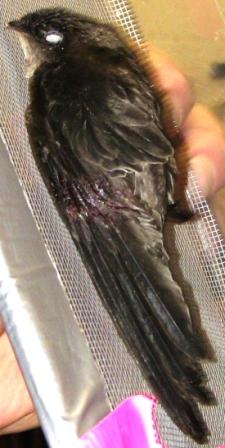
Have you heard chirping noises in your chimney and wondered what it was? Chances are you have probably heard the chattering of Chimney Swifts, a unique species of bird that nest only in chimneys. Lake Erie Nature & Science Center’s Wildlife Education & Rehabilitation staff receives many calls about these birds at this time of year as it is their primary nesting season.
Sometimes called “flying cigars” Chimney Swifts are small, dark colored birds with long pointed wings and stiff tails. The only swifts commonly found in eastern North America, they have a cylindrical body and tend to be similar in appearance to swallows. Just like bats, swifts are aerial foragers whose diets consist primarily of flying insects.
Instead of perching like most birds, swifts use their long claws to grasp chimneys and other vertical surfaces. They are often in flight, and even bathe while flying! Swifts are able to fly over a body of water, smack the water with their breast and then bounce back up, shaking off excess water from their feathers as they fly away.
Chimney Swifts are also known for their distinctive nest construction. The parents weave small twigs together in the shape of a half-saucer and then glue the nest to the side of a chimney with their saliva. Their nests can hold anywhere from 1-5 eggs.
Although Chimney Swifts are not currently a species of concern, their population numbers are decreasing across their range because they are losing nesting sites. A contributing factor may be that construction of chimney flues have become narrower and covered, leaving Chimney Swifts fewer places to nest.
Wildlife Rehabilitation Coordinator Amy LeMonds has found Chimney Swifts nesting in the Center’s chimney this summer. According to LeMonds, another factor limiting nesting sites for Chimney Swifts are that people buy caps for their chimneys to keep raccoons out, but in doing so they also prevent Chimney Swifts from nesting.
LeMonds recommends that homeowners purchase caps that are large enough to let swifts in but can still keep raccoons at bay. Additional information on how to make your chimney a good habitat for Chimney Swifts can be found online from the Chimney Swift Nest Site Research Project.
According to LeMonds, swifts can be difficult to rehabilitate. In most cases, if you find a baby Chimney Swift, the best thing you can do for it is to stick it back up in the chimney flue so that its parents can care for it. If you find a baby bird and are unsure of what to do or if you have any wildlife questions, please call Lake Erie Nature & Science Center at 440-871-2900.
Monday, July 25, 2011
What is chirping in my chimney?
Posted by
Joanna Galysh, Community Relations Intern
0
comments
Wednesday, July 20, 2011
Be On the Lookout for Cedar Waxwings!
Have you ever seen a beautifully colored bird dining on a feast of berries? Then you are likely looking at a Cedar Waxwing, a type of bird typically found in wooded areas and near farms, orchards and suburban homes where berry trees and bushes are plentiful. They have a large head with a short neck and bill and are adorned with a variety of colors. Cedar Waxwings have brown heads that fade to gray on their wingtips, yellow bellies, a black face mask outlined in white and their namesake waxy red tips on the end of their wings.
At this time of year, Lake Erie Nature & Science Center receives many calls asking about these birds because it is their peak nesting season. Cedar Waxwings are unique because they are very social birds that tend to flock and dine together. Wherever one Cedar Waxwing can be found, there are bound to be more.
A distinctive part of the Cedar Waxwing’s diet is their love for berries and their ability to eat them whole, including seeds. Cedar Waxwings are one of the few birds in North America that eat fruit and can even live on fruit alone for a few months at a time. Sometimes Cedar Waxwings accidentally eat berries that have begun to ferment, causing them to become intoxicated and in some cases even die from alcohol poisoning. Lake Erie Nature & Science Center has fielded calls about large groups of these birds falling over on the ground or out of the sky, drunk from eating fermented berries. There have even been recent instances of this behavior in the national news as well.
Despite their fancy for fruit, berries are not the only component of the Cedar Waxwing’s diet. They also fly over water looking for insects to catch. Baby Cedar Waxwings in particular need to eat bugs to maintain proper calcium levels. Sometimes people feed baby Cedar Waxwings berries thinking that they are helping their development, when in fact they are hindering it. Cedar Waxwing babies cannot receive enough calcium from eating berries alone and can suffer bone deformation.
Not only are they unique in their feeding habits, but Cedar Waxwings also have unusual mating tendencies. During courtship, males and females will hop toward each other, alternating back and forth and occasionally
touching bills. Males will typically pass a small item such as a berry, insect or flower petal to the female who will hop away and then return the item to the male. This strange dance is repeated a few times until the female eats the gift.
In nest building, the male and female both search for a good location, but it is ultimately the female’s decision to choose a nesting spot. Females also do almost all of the nest construction, which can take up to 5-6 days and may require up to 2500 individual trips to the nest. Cedar Waxwing nests are constructed of twigs, grass, cattails, string, horsehair and even remnants of other birds’ nests.
Cedar Waxwing populations are increasing throughout their range and they are not currently a species of concern. For additional information on Cedar Waxwings, please click here. If you have any questions about Cedar Waxwings or other wildlife, please contact Lake Erie Nature & Science Center at 440-871-2900.
Posted by
Joanna Galysh, Community Relations Intern
0
comments
Wednesday, July 13, 2011
You Can Make a Difference At Your Beach!
Are you passionate about the health of Huntington Beach and its usability for future generations? If so, be certain to attend the kick-off meeting for the Great Lakes Restoration Initiative (GLRI) right here at Lake Erie Nature & Science Center on July 27 at 6:30 p.m.
In collaboration with the Cuyahoga County Board of Health, Cleveland Metroparks, Cuyahoga Soil and Water Conservation District, University of Toledo, and the cities of Bay Village and Westlake, Lake Erie Nature & Science Center will be helping to improve water quality at Huntington Beach.
The U.S. EPA has granted over $247,000 for the project, “A Holistic Watershed Approach to Health at Huntington Beach.” As an individual component of a national restoration effort, the improvements at Huntington Beach will have far-reaching effects on the rest of the lake. Through this project, citizens will have the opportunity to become more educated about potential pollution sources feeding into the Porter Creek watershed and can even participate in clean-up activities that show how an individual really can make a difference in water quality.
The project continues through 2013, so there will be plenty of opportunities for community involvement! Future events include storm drain sketching, measuring bacteria levels and teacher workshops which include Project Wet and a rain barrel workshop that can be utilized in the classroom.Anyone interested in helping with the monitoring or prevention efforts of the GLRI should plan to attend the July 27 kick-off at Lake Erie Nature & Science Center. The grant will be explained, an activity will be provided for children and a preliminary survey to test your knowledge about watershed protection will be given. Additional information is available at the Great Lakes Restoration Initiative Website.
To further encourage the improvement of the health of Lake Erie, the Center will be hosting family-friendly Adopt-A-Beach events in August, September and October to record data on beach conditions. This information will be entered into a database to help improve Lake Erie’s water quality. For more information on Lake Erie Nature & Science Center’s programs, please click here.
Posted by
Joanna Galysh, Community Relations Intern
0
comments
Monday, June 27, 2011
Why Do Turtles Cross the Road? To Get to the Other Side (Honestly)!
The repair on a turtle’s shell can take as long as a few years depending on the placement and depth of the crack. The Center’s Wildlife Rehabilitation staff nursed a snapping turtle back to health for two years after it suffered a shell injury. We expect to keep the currently injured turtles in rehabilitation until at least next year.
This is a very dangerous time of year for these turtles because it is their peak nesting season. From May-July, painted turtles will leave the safety of their pond, river or lake and travel to their nesting grounds to lay eggs. Turtles return to the same place to nest every year, even if it is miles away from their home or over dangerous terrain.
Painted turtles can lay anywhere from 4-15 eggs when they nest. After burying the eggs, they return to the water, providing no parental care for the eggs or the babies that hatch. The gender of the eggs depends upon the temperature of the nesting grounds at the time they hatch. Warmer temperatures tend to produce females, whereas cooler temperatures tend to produce males.
In the United States there are many subspecies of painted turtles, but only the Midland painted turtle is found in Ohio. They have a red and black coloration along the underside of their plates that gives the appearance of being painted on by hand.
Painted turtles prefer to live in quiet and shallow freshwater areas. During warm summer days they can be seen basking in the sun on rocks and logs. During the winter, painted turtles will seek deeper water and burrow into the mud at the bottom. They slow their heart rate and absorb oxygen through their skin.
If you see a turtle that you think is in need of help, please call Lake Erie Nature & Science Center at 440-871-2900 prior to attempting a rescue. Again, though, please do NOT jeopardize your safety by attempting to rescue any animal.
Posted by
Joanna Galysh, Community Relations Intern
0
comments
Monday, June 20, 2011
Fear Not for Fledglings!
Have you seen a baby bird on the ground, unable to fly, and wondered if it was injured? Fortunately, Lake Erie Nature & Science Center is here to answer your question!Throughout the month of June especially, the Center receives an abundance of calls asking whether or not young birds that appear to be “stuck” on the ground need human assistance. In most cases, the answer is no.
During a baby bird’s fledgling period, it jumps out of the nest and lives on
the ground for a few days. This part of a young bird’s life can be very dangerous, but it is a necessary part of development. Fledglings learn to fly, feed themselves and respond to danger during this time and cannot learn these things well in captivity. Humans should NOT intervene unless they are certain that the bird is injured because any young animal’s best chance for survival is in the wild.Please call Lake Erie Nature & Science Center at 440-871-2900 with any wildlife questions before attempting a rescue. For additional information on what to do if you see a fledgling on the ground that you are concerned about, please see our Wildlife FAQ on fledglings.
Posted by
Joanna Galysh, Community Relations Intern
0
comments
One of Nature's Greatest Hunters is in for Recovery After a Smelly Defeat
One of rehab’s newest patients is in our care after losing a foul-smelling encounter with its prey. The great horned owl is one of the Striped Skunk’s only natural predators, but this particular owl that was brought in to us was not successful in his attempt to make a skunk his meal.
Although great horned owls are incredibly strong and have no natural predators in this area, they are not invincible. Our patient came in with puncture wounds to his foot and skunk spray covering his body, including his eyes. Our rehabilitation staff was able to clean out his wound and rinse the skunk spray out of his irritated eyes. We are hopeful for a successful recovery for this majestic bird of prey.
Great horned owls are the largest owls that breed in Ohio. Male and female great horned owls are identical in appearance; however the female tends to be larger than the male. They are one of the three common Ohio owls found in all three major habitats, rural, suburban and even urban. Because they prefer some open area for hunting, great horned owls tend to avoid extremely forested terrain. They can best be found by hearing their traditional hoo-hoo-hooo call.
Great horned owls are the earliest birds to nest, but instead of building their own nests, they use the abandoned nests of hawks, eagles, squirrels and other nesting animals. They prefer nests in large, old trees, but if those are unavailable, they will use old buildings, cliffs and if absolutely necessary, the ground. Great horned owls are monogamous mates and the male will remain with the female, even helping to bring food for her and the owlets once they have hatched.
As always, if you see an animal that you believe to be injured or if you have backyard wildlife questions, please contact Lake Erie Nature & Science Center at 440-871-2900.
Posted by
Joanna Galysh, Community Relations Intern
0
comments
Monday, June 13, 2011
Foster Families in Nature
| Cheaper By the Dozen - The addition of a twelfth gosling doesn't phase this family. |
One of the goslings was injured by jumping or falling off the roof of Westlake High School where his parents had made a nest. Groundskeepers at the school found him dragging his leg and brought him to the Center's where he was given a ‘boot’ to help his leg heal and the opportunity to recover peacefully.
Although the releases were completed successfully, it can be very difficult to return young animals back into the wild once they are separated from their families. As shown in the video below, our rehabilitation staff had to exercise caution and keep their distance during the release because parent geese are very protective and will charge at anyone who approaches their young too closely.
Geese will accept other baby geese into their family only if they are the same size or smaller than their own young. The same cannot be said of mallard ducks. Rehabilitation staff must find the original family to return the baby to when releasing injured ducklings because any attempt to place the baby with a foster family ends in rejection.
Our rehab staffers emphasize that they only take in baby animals that are seriously injured because human care should be a last resort. We strongly urge you to call Lake Erie Nature & Science Center at 440-871-2900 prior to attempting to rescue any wildlife, especially babies. Oftentimes baby animals are mistaken for being orphaned or injured when they are simply exhibiting normal wildlife behavior. Their best chance for survival is in the wild where their family can care for them.
You'll find more information in the June 14 issue of the Westlake | Bay Village Observer.
Posted by
Joanna Galysh, Community Relations Intern
0
comments
Monday, June 6, 2011
Please Pick Up Your Fishing Lines and Lures!
Our patient was a lucky one. Injuries from fishing line tend to be serious because the line can act as a tourniquet, cutting off blood flow and nerve supply to the affected area. If the animal is not treated quickly, muscles and tendons may be damaged. The worst cases result in an amputation of the animal’s arm, leg, wing or other affected body part.
Other injuries can result from leftover fishing lines and lures. Animals may swallow lines and hooks and become poisoned or starve to death. Their feet may become tangled or their bodies can become wrapped up in the line, often resulting in immobility and death.
Posted by
Joanna Galysh, Community Relations Intern
0
comments