Showing posts with label Rehabilitation. Show all posts

Monday, June 27, 2011

Why Do Turtles Cross the Road? To Get to the Other Side (Honestly)!

Three midland painted turtles are in the care of the Wildlife Education & Rehabilitation staff at Lake Erie Nature & Science Center after sustaining shell injuries from getting hit by cars while crossing the road.

The repair on a turtle’s shell can take as long as a few years depending on the placement and depth of the crack. The Center’s Wildlife Rehabilitation staff nursed a snapping turtle back to health for two years after it suffered a shell injury. We expect to keep the currently injured turtles in rehabilitation until at least next year.

This is a very dangerous time of year for these turtles because it is their peak nesting season. From May-July, painted turtles will leave the safety of their pond, river or lake and travel to their nesting grounds to lay eggs. Turtles return to the same place to nest every year, even if it is miles away from their home or over dangerous terrain.

Nothing will stop a turtle when trying to reach its nesting grounds. These determined little fellows will fearlessly cross a busy street. If you feel interference is necessary (and it can be done without compromising your own safety!) then it's best to help the turtle across the street in the direction that it is headed. If you move it to a “safer” location, you may have inadvertently done it a disadvantage by placing it farther away from its nesting grounds. Painted turtles will not harm you, but if you see a snapping turtle crossing the road, it is best to let them cross unaided as their bite can be quite powerful.

Painted turtles can lay anywhere from 4-15 eggs when they nest. After burying the eggs, they return to the water, providing no parental care for the eggs or the babies that hatch. The gender of the eggs depends upon the temperature of the nesting grounds at the time they hatch. Warmer temperatures tend to produce females, whereas cooler temperatures tend to produce males.

In the United States there are many subspecies of painted turtles, but only the Midland painted turtle is found in Ohio. They have a red and black coloration along the underside of their plates that gives the appearance of being painted on by hand.

Painted turtles prefer to live in quiet and shallow freshwater areas. During warm summer days they can be seen basking in the sun on rocks and logs. During the winter, painted turtles will seek deeper water and burrow into the mud at the bottom. They slow their heart rate and absorb oxygen through their skin.

If you see a turtle that you think is in need of help, please call Lake Erie Nature & Science Center at 440-871-2900 prior to attempting a rescue. Again, though, please do NOT jeopardize your safety by attempting to rescue any animal.

Monday, June 20, 2011

One of Nature's Greatest Hunters is in for Recovery After a Smelly Defeat

One of rehab’s newest patients is in our care after losing a foul-smelling encounter with its prey. The great horned owl is one of the Striped Skunk’s only natural predators, but this particular owl that was brought in to us was not successful in his attempt to make a skunk his meal.

Although great horned owls are incredibly strong and have no natural predators in this area, they are not invincible. Our patient came in with puncture wounds to his foot and skunk spray covering his body, including his eyes. Our rehabilitation staff was able to clean out his wound and rinse the skunk spray out of his irritated eyes. We are hopeful for a successful recovery for this majestic bird of prey.

Great horned owls are the largest owls that breed in Ohio. Male and female great horned owls are identical in appearance; however the female tends to be larger than the male. They are one of the three common Ohio owls found in all three major habitats, rural, suburban and even urban. Because they prefer some open area for hunting, great horned owls tend to avoid extremely forested terrain. They can best be found by hearing their traditional hoo-hoo-hooo call.

Male and female great horned owls are identical in appearance, but the females are larger than the males although this can be hard to detect without actually weighing them. They have an almost “tiger-like” striping on their chest and belly which is one reason for their nickname “Tiger of the Woods.” Great horned owls also have a patch of white feathers under their chin, giving them an even more unique appearance.

Great horned owls are the earliest birds to nest, but instead of building their own nests, they use the abandoned nests of hawks, eagles, squirrels and other nesting animals. They prefer nests in large, old trees, but if those are unavailable, they will use old buildings, cliffs and if absolutely necessary, the ground. Great horned owls are monogamous mates and the male will remain with the female, even helping to bring food for her and the owlets once they have hatched.

As always, if you see an animal that you believe to be injured or if you have backyard wildlife questions, please contact Lake Erie Nature & Science Center at 440-871-2900.

Monday, June 13, 2011

Foster Families in Nature


Cheaper By the Dozen - The addition of a
twelfth gosling doesn't phase this family.
 Lake Erie Nature & Science Center successfully released two young goslings into new "foster families" at Westlake’s Clague Park, following treatment by our rehabilitation staff for leg injuries.

One of the goslings was injured by jumping or falling off the roof of Westlake High School where his parents had made a nest. Groundskeepers at the school found him dragging his leg and brought him to the Center's where he was given a ‘boot’ to help his leg heal and the opportunity to recover peacefully.

Although the releases were completed successfully, it can be very difficult to return young animals back into the wild once they are separated from their families. As shown in the video below, our rehabilitation staff had to exercise caution and keep their distance during the release because parent geese are very protective and will charge at anyone who approaches their young too closely.

Geese will accept other baby geese into their family only if they are the same size or smaller than their own young. The same cannot be said of mallard ducks. Rehabilitation staff must find the original family to return the baby to when releasing injured ducklings because any attempt to place the baby with a foster family ends in rejection.

Our rehab staffers emphasize that they only take in baby animals that are seriously injured because human care should be a last resort. We strongly urge you to call Lake Erie Nature & Science Center at 440-871-2900 prior to attempting to rescue any wildlife, especially babies. Oftentimes baby animals are mistaken for being orphaned or injured when they are simply exhibiting normal wildlife behavior. Their best chance for survival is in the wild where their family can care for them.

You'll find more information in the June 14 issue of the Westlake | Bay Village Observer.

Monday, June 6, 2011

Please Pick Up Your Fishing Lines and Lures!

Our Wildlife Education & Rehabilitation Program has taken in many patients due to injuries caused by fishing lines and lures left on beaches.
During the spring season, we treated a young ring-billed gull for a wing injury caused by fishing line. A concerned citizen brought him in, and we were able to cut the barbs and remove the fishing line from his wing. Fortunately, his wing was only left with minor lacerations.

Our patient was a lucky one. Injuries from fishing line tend to be serious because the line can act as a tourniquet, cutting off blood flow and nerve supply to the affected area. If the animal is not treated quickly, muscles and tendons may be damaged. The worst cases result in an amputation of the animal’s arm, leg, wing or other affected body part.

Other injuries can result from leftover fishing lines and lures. Animals may swallow lines and hooks and become poisoned or starve to death. Their feet may become tangled or their bodies can become wrapped up in the line, often resulting in immobility and death.

Birds are not the only animals affected by fishing line. Almost any animal living in or around a body of water, including fish, otters and turtles, can be hurt by fishing debris. Many of the injured animals are never found.

Fishing is an enjoyable pastime for many but we would ask everyone who participates in the sport to be mindful of the wildlife around you. Please be certain to take all of your supplies back with you to avoid potentially fatal injuries to wild animals.

If you see a wild animal that has been injured or want backyard wildlife advice, please contact Lake Erie Nature & Science Center at 440-871-2900.

Thursday, June 2, 2011

Opossums- an Exception to the Rule

Our Wildlife Education & Rehabilitation Program at Lake Erie Nature & Science is currently treating six baby opossums who were found orphaned in the road without Mom and were too young to live without her milk.
Lake Erie Nature & Science Center typically does not take in orphaned babies because they usually have a better chance for survival in the wild.

Opossums, however, are different. They are North America’s only marsupials, meaning Mom carries her babies around in her pouch, just like a kangaroo. Opossum mothers do not nest and are often on the go. In this particular case, Mom was likely killed by a car, leaving her babies helpless.

Baby opossums are carried in Mom’s pouch until they are 2-3 months old and are then carried on her back for another 1-2 months. Opossums have a short life span of only 2-4 years and while young, they rely on Mom for the protection of her pouch and her milk for food.

If you see any animal that appears to be orphaned or injured, please contact Lake Erie Nature & Science Center at 440-871-2900 for more information before attempting a rescue.

Wednesday, May 25, 2011

Injured Baby Hawks Facing Long Rehab

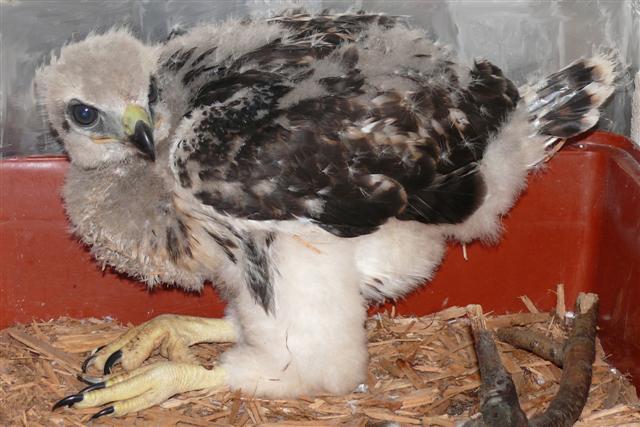
Two baby hawks rescued from a tree that came crashing down in Monday night's storm are now in the care of Lake Erie Nature & Science Center.


Troy and Marci Anderson, the Berea couple who rescued the nestlings from the fallen nest and tree, brought them to our Wildlife Education & Rehabilitation Program staff yesterday. After a visit to the vet, the birds are starting what looks to be a long-term rehab, recovering from leg fractures.
Both nestlings were hand-fed a good morning meal today and received anti-inflammatory meds. We're keeping them contained and limiting movement to promote healing of the fractured legs. They'll be returning to the vet in a week to remove bandages and re-xray the legs.

We posted a whole album of photos this morning on our Facebook page and WKYC-TV Reporter Jennifer Lindgren filed a terrific report on Channel 3 last night, complete with video of the adorable babies. As Jennifer notes, our nonprofit rehab services are offered at no cost to public and are supported through donations. Want to help these patients and others? You can donate online now.

Here's our own "LENSCTube" video clip from breakfast: http://www.youtube.com/watch?v=4ytG-Ifioew

Thursday, May 19, 2011

Rehab's Pretty Patient- the Pileated Woodpecker

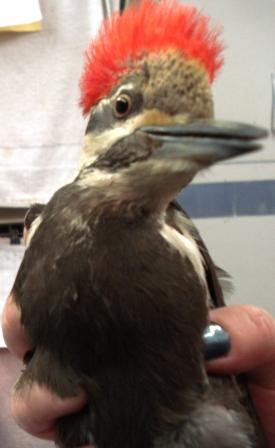
Our Wildlife Education & Rehabilitation Program has a fascinating and beautiful avian patient in treatment this week—a pileated woodpecker that suffered head trauma, most likely after flying into a window.

Pileated woodpeckers are similar in size to a crow and are the largest woodpeckers found in the majority of North America. The call of the pileated woodpecker has a loud and resonant “kuk-kuk-kuk” sound. Listen to their call by clicking here.

These birds also have a distinctive red crest on their heads and live in deciduous and coniferous forests with large trees, which they prefer for nesting. The pileated woodpecker will create a nesting cavity in a dead tree and empty it completely except for wood shavings.

Pileated woodpeckers also engage in an unusual behavior in searching for food. They dig rectangular holes in trees to search for ants. Sometimes, when digging holes in small trees, they create holes so deep that the tree may actually break in half!

The pileated woodpecker population encountered a large decline with the clearing of eastern forests, but their numbers have been making a comeback since the mid-20th century. They are not considered to be a species of concern.

If you see a bird or other animal that you believe to be injured, or if you have backyard wildlife questions, please contact Lake Erie Nature & Science Center at (440) 871-2900.

Monday, May 16, 2011

Birds on the Road to Recovery in Rehab

Our Wildlife Education & Rehabilitation Program is just starting the busy season right now, so it can be difficult to pause long enough to share cool animal photos and stories. We did manage to photograph three current avian patients during treatment this week.

The first is a female Rose-breasted Grosbeak with an injured leg. Grosbeaks live in any type of woods, and have a very distinctive song that is said to sound similar to that of a robin, but more melodic, as if it were sung by an opera singer. The Center also has a male Rose-breasted Grosbeak. Click here to see the differences between the male and female Grosbeaks and to hear their song.


We also have a female Belted Kingfisher that is being treated for a fractured clavicle(collar bone). Unlike most bird species, the female Belted Kingfishers are more colorful than males, with a rust-colored band on their breast. Kingfishers are known for having a large head and bill for their small body size, which allows them to easily catch fish. They can even dive at 25 mph from great heights while hunting! The Belted Kingfisher can live in any area where there is an open body of water.


Another bird currently in treatment for a wing injury is a baby Rock Pigeon. Although many people often see pigeons as “dirty city birds”, humans have valued them for thousands of years for many reasons including as food and to carry messages. Their natural environment is rocky cliffs in the mountains and coasts of Europe. They are highly adaptable often utilizing man-made structures such as bridges and buildings for nesting which has allowed them to establish healthy populations worldwide.

The rescuer of the baby Rock Pigeon is actively searching to find the roost site in the hope that we can return the baby to its nesting family following treatment. Wild baby animals belong in the wild to learn from their parents. Please do not approach a baby animal unless it has been seriously injured.

Oftentimes baby animals may appear to be abandoned, when in fact the parents are staying away to protect them. A baby animal’s best chance of survival is to remain in the wild where their mother can care for them. If you have questions regarding a wild animal, please call Lake Erie Nature & Science Center at (440) 871-2900.

Wednesday, April 27, 2011

Fox Family Shares NE Ohio Home

One of our great Wildlife Education & Rehabilitation volunteers has a front row view of spring baby season and was kind enough to share her photos with us! A Red Fox has created a den under the her deck and, at this time of year, the kits are starting to explore with the parents.

Wildlife Rehabiltiation Coordinator Amy LeMonds says that it's not uncommon to see a fox family out during the day while the kits are in this learning stage of life, even though these animals are typically nocturnal. We estimate that the kits in the photos are probably a couple months old.

Our volunteer reports that mom is an excellent hunter and is observed providing animals to the kits daily. The youngsters will soon become more successful hunting on their own but stay with their family for up to 9 months.

You never know who or what will wind up sharing your backyard (or deck, if you let them) in Northeast Ohio. We're not disclosing the location of our volunteer's home to make sure both the human and fox families maintain privacy.


Saturday, January 22, 2011

American White Pelican in Rehab

We’re caring for an unusual patient in Wildlife Education & Rehabilitation Program an American White Pelican. Although a few of these birds wind up in our neck of the woods each year, it’s rarely seen in Ohio because the American White Pelican’s normal breeding range is the Northern Plains and Mountain West and it winters along the southern coasts.


The snowy white pelican with black edged wings was picked up in the Cuyahoga River and brought to us on January 19. It had been observed injured for a few days and we immediately noted an obvious left wing injury. An x-ray and veterinary exam revealed no fracture. We are currently treating for a soft tissue injury, keeping the wing stable with a wrap.

Some of the photos we have posted on our Facebook page were taken as Wildlife Rehabilitation Coordinator Amy LeMonds and Wildlife Director Dave Wolf worked to keep the bird eating. (One shot shows the pelican’s amazing open mouth and its long bill with extensible pouch.) The American White Pelican is one of the largest birds in North America .

Friday, December 17, 2010

Variety of Water Birds Seen In Rehab

This week’s intense wintry weather brought an influx of injured water birds into our Wildlife Education & Rehabilitation Program. It’s common for us to see quite a few of these birds each winter, but we don’t always encounter such variety of species at once.

Wildlife Rehabilitation Coordinator Amy LeMonds identified the birds sharing rehab quarters this week as 2 Pied-bill Grebes and 2 Horned Grebes, along with a Canvasback duck and 2 Ruddy ducks.

The grebes have legs that are set far back on their bodies, ideal for propelling them through the water and diving for dinner but not for walking.

This body arrangement also means that they cannot take flight without paddling across the surface of water.This time of year, grebes can get stuck on snow-covered frozen lakes or in shallow puddles that collect on land. Often, all that is required of us is that we get them to open water to restore their ability to take flight.

We were already able to return 3 of the grebes and 2 of the ducks to Lake Erie this week, in the warm open water near the Avon Lake power plant.

Monday, September 20, 2010

Fall Brings Wild Babies, too

Calls and assistance are picking up again as our Wildlife Education & Rehabilitation Program handles another round of wildlife baby season. Although we usually think “spring” is when we encounter baby wildlife, many animals produce a second wave of offspring in the late summer or early fall.

Whenever a wild baby is healthy and active, we advise that the best course of action for the animal is to return them back to the wild. Better yet, we hope you'll call us before you interfere (440-871.2900 ext. 204!)
 

Infant Eastern Cottontail
Eastern Cottontails are among the wildlife still reproducing in the autumn. Baby bunnies are almost never abandoned, even when they are all alone.In order to minimize the risk of attracting predators, females only come to their nest at dusk and dawn to feed and groom their babies. A young rabbit, chipmunk-sized or bigger, is completely independent of its mother and should be left alone.

 Cottontails have a very low tolerance for stress and when kept in captivity, they very often die. Nests are often in the middle of the yard in what seems like a “bad” place but do not move the rabbits, as the mother probably won’t be able to find them. Cottontails regularly survive growing up in a typical suburban yard even with dangers like cats, kids and even dogs.
Infant Eastern Fox Squirrel

In the case of baby squirrels, which are also among the wildlife offspring you'll see in the fall, it’s not uncommon for young squirrels to show a lack of fear of humans. Even if they run right up to you, this doesn’t mean they need your help! Let them continue learning to be wild. You can help them learn a necessary and healthy fear of humans by clapping or making other loud noises to send them on their way. In fact, “What to do about friendly baby squirrels?” is Number 5 on our Frequently Asked Wildlife Rehab Questions list.

If a squirrel’s eyes are not open yet, you can secure an artificial nest to the tree using a tupperware container with holes in the bottom. Mom is able to retrieve her babies and take them back to the nest. An artificial nest can help protect the baby until it can be located by mom.

-Amy LeMonds, Wildlife Rehabilitation Coordinator

Friday, July 23, 2010

Wildlife Rehab Update - Kingfisher Release

We hope you caught the Westlake-Bay Observe story about the three feathered "fishermen" who rehabbed with us this summer. When our talented Communications Intern, Katie Ferman, originally wrote the story, the Kingfisher patient was doing well but not yet ready to return to the wild. We thought we'd let you know that we wound up with a "three for three" success rate in this particular case.


Before the Kingfisher was released, it was banded. You can read about the benefits of bird banding here. The photos here of the Kingfisher preparing to feast on goldfish were taken by our Seasonal Wildlife Specialist Tim Jasinski.

Sunday, July 18, 2010

Follow-up: Good News From Shaker Hawk Re-Nesting

We've had some encouraging reports on that baby hawk our Wildlife Education & Rehabilitation Program staff attempted to returned to its family in Shaker Heights using an artificial nest. You'll recall the baby hawk had fallen from a high nest, was rescued by a passerby and brought to us for evaluation and care. We went up in a city bucket truck to get the baby and an artificial nest as close to its original nest (and sibling) as possible.

This past week, the homeowner's neighbors spotted BOTH youngsters up in the branches... a sighting that's a very positive sign that the re-nesting worked and the baby has joined its sibling as a "branchling." 

Friday, June 25, 2010

Baby Hawk Re-Nested With Bucket Truck

Lake Erie Nature & Science Center wildlife staff returned a baby red-tailed hawk back to nature in Shaker Heights today using a bucket truck from the City of Shaker Heights Public Works Department. The hawk fell from its nest and was spotted by a passerby who contacted our Wildlife Education & Rehabilitation Program. Rehab staff had been caring for the unharmed bird since June 14.

To return the young hawk to its wild family, Wildlife Rehabilitation Coordinator Amy LeMonds determined where the bird was found, contacted the homeowners and worked with the City of Shaker Heights on a re-nesting plan. LeMonds fashioned an artificial nest out of a laundry basket, attaching rough matting to the top edges to provide traction for the bird’s talons. Artificial nests are often successful in reuniting a baby bird back with its natural parent caretakers when the original nest cannot be reached or is destroyed. In this case, the hawk nest was beyond the reach of the bucket truck.

This morning, a City of Shaker Heights Public Works Wildlife crew attached the artificial nest to the tree below the natural nest using a ratcheting strap. Wildlife Director Dave Wolf then made the bucket trip back up and placed the baby into the secured basket. The hawk is now reaching ‘branchling’ stage, when it will be hopping from branch to branch, strengthening its muscles and learning to fly, still under the care of mom and dad. The baby appeared to be in great shape after being placed in the basket, almost immediately eating the food supplied by the rehab staff.
The parents have been observed tending to a sibling in the original nest.

Center rehab staff often teaches would-be baby bird “rescuers” to place displaced birds back in their original nests or to use the artificial nest method. For small birds, a milk carton makes an excellent hanging artificial nest.

The nonprofit Lake Erie Nature & Science  relies on donations to fund our Wildlife Education and Rehabilitation Program, which provides services at no charge to the public. To donate or for more information, stop by 28728 Wolf Road in Bay Village, call 440-871-2900, email info@lensc.org or visit www.lensc.org online.

These photos provided by the City of Shaker Heights. Visit our Facebook page for a full album of photos!

Saturday, June 19, 2010

Rehab Story: Nestling Red-tail Hawk

A fuzzy, young Red-tailed Hawk that fell from a high nest in Greater Cleveland is one of many current animal patients that Lake Erie Nature & Science Center ’s Wildlife Education and Rehabilitation Department is working to return to the wild.

Our rehab staff is coordinating with city local officials to find a way to reunite this nestling hawk with its parents. The nest has been located (with a sibling inside) but it is very high up in the tree. If we’re not able to reach the nest with a bucket truck, we hope to be able to reunite this young bird with its wild parents as a branchling. The bird is almost to this branchling stage, where it leaves the nest, but remains on a nearby branches where mom and dad continue to offer food and to teach their offspring the skills necessary to survive in the wild, including how to hunt.

Red-tailed hawks can fly at 9 weeks but still depend on their parents for food. At 15 weeks, they are capable of being on their own but will continue to hang around parents. They don't actually get their red tail until they are a year old.

Our Rehab has been especially busy in recent weeks… so busy, we haven’t been able to pause and tell many of our stories here. Our Community Relations staff is taking time to shadow us to help keep you posted our busy season activities. So, watch our Blog and Social Media sites for more rehab stories in the coming days and weeks.

Tuesday, June 15, 2010

Pink Pepto and Dawn Tools In Oiled Wildlife Rehab

How do wildlife rehabbers help birds affected by the oil in the Gulf of Mexico? Pink Pepto and Dawn Detergent are two of the tools. Lake Erie Nature & Science Center Wildlife Director Dave Wolf and Wildlife Rehabilitation Coordinator Amy LeMonds gave a step by step demonstration of the stabilization and cleaning process yesterday on WKYC-TV Channel 3.
Watch the full segment from yesterday's Good Company program at this this Channel 3 website link.


Wednesday, June 9, 2010

Wildlife Response to Deepwater Horizon Oil Spill

We've had a number of questions to our Wildlife Education & Rehabilitation Program about wildlife rehab for the Deepwater Horizon oil spill in the Gulf of Mexico. In fact, Wildlife Rehabilitation Coordinator Amy LeMonds was interviewed for a report on WKYC-Channel 3 this morning.

We're referring callers to Tri-State Bird Rescue and Research of Delaware, an organization leading the wildlife rescue efforts following the Deepwater Horizon incident. Tri-State's oil spill response team has been on the Gulf Coast since the last week in April and is working with their West Coast colleagues, International Bird Rescue Research Center, and the U.S. Fish & Wildlife Service to manage the rehabilitation of oiled wildlife.

Friday, April 30, 2010

Beautiful Loon Wild and Free Again

Diving birds have legs that are set far back on their bodies, as you can see in some of the photos of an uncommonly beautiful “Common Loon” which came into our Wildlife Education & Rehabiliation Program this week. The placement of the legs and feet on these birds is ideal for propelling them through the water and diving for dinner, but not so great for walking. In fact, some of these birds can’t even walk on land and they require open water for proper take-off.

The loon in these photos was picked up from a ditch in town of Wellington with no major injuries -- just a scratch on the foot, perhaps due to a struggle to take off from a hard surface.

Once Lake Erie Nature & Science Center's rehab staff had a chance to check out the injuries and determine the bird is largely in good health, the best course of action was to get this loon back to open water. In this case, we released this bird on Lake Erie. There, take off and landing should be smooth sailing.
We generally see these birds during the spring and fall migration seasons since NE Ohio is right on the edge of the territory that provides their northern summer nesting grounds.

Thanks to our new Seasonal Wildlife Specialist, Tim Jasinski, who took the photos of this Common Loon that's now wild and free again.


Friday, April 16, 2010

Birds Fly Into Windows Attacking Their Own Reflection

Once again this spring, our wildlife staff is answering many phone calls about birds repeatedly flying into windows. This is a common occurrence during mating and nesting season, particularly with cardinals and robins because of their bright colors. What causes this behavior? The bird is seeing its reflection in the window and thinks another bird is invading its territory.

A possible remedy is to tape newspaper or wax paper to the OUTSIDE of the window. This behavior is likely to diminish as each individual bird's breeding season progresses (usually after a few weeks).


This behavior is noted all over the world. This very cool series of photos of a Grey Wagtail confronting its reflection were taken in India this Spring and posted on the Bird Ecology Study Group website. The image is by Ganesh Mani Pradhan & Son.

Our more detailed explanation of the phenomenon can be found in the Frequently Asked Questions (FAQ's) section on Lake Erie Nature & Science Center's website. This is such a common occurrence, "There's a bird repeatedly flying into my window, how can I make it stop?" is the number two FAQ on our list.
 
If you need more information, you can call the Kenneth A. Scott Wildlife Education & Rehabilitation Program at (440) 871-2900 ext 204 between the hours of  10 a.m. and 5 p.m. seven days a week.