
Have you heard chirping noises in your chimney and wondered what it was? Chances are you have probably heard the chattering of Chimney Swifts, a unique species of bird that nest only in chimneys. Lake Erie Nature & Science Center’s Wildlife Education & Rehabilitation staff receives many calls about these birds at this time of year as it is their primary nesting season.
Sometimes called “flying cigars” Chimney Swifts are small, dark colored birds with long pointed wings and stiff tails. The only swifts commonly found in eastern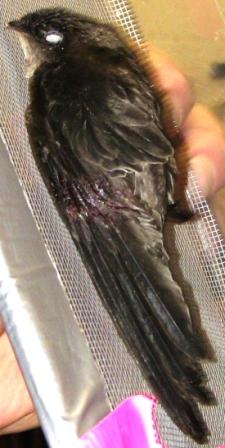 North America, they have a cylindrical body and tend to be similar in appearance to swallows. Just like bats, swifts are aerial foragers whose diets consist primarily of flying insects.
Instead of perching like most birds, swifts use their long claws to grasp chimneys and other vertical surfaces. They are often in flight, and even bathe while flying! Swifts are able to fly over a body of water, smack the water with their breast and then bounce back up, shaking off excess water from their feathers as they fly away.
Chimney Swifts are also known for their distinctive nest construction. The parents weave small twigs together in the shape of a half-saucer and then glue the nest to the side of a chimney with their saliva. Their nests can hold anywhere from 1-5 eggs.
Although Chimney Swifts are not currently a species of concern, their population numbers are decreasing across their range because they are losing nesting sites. A contributing factor may be that construction of chimney flues have become narrower and covered, leaving Chimney Swifts fewer places to nest.
Wildlife Rehabilitation Coordinator Amy LeMonds has found Chimney Swifts nesting in the Center’s chimney this summer. According to LeMonds, another factor limiting nesting sites for Chimney Swifts are that people buy caps for their chimneys to keep raccoons out, but in doing so they also prevent Chimney Swifts from nesting.
LeMonds recommends that homeowners purchase caps that are large enough to let swifts in but can still keep raccoons at bay. Additional information on how to make your chimney a good habitat for Chimney Swifts can be found online from the Chimney Swift Nest Site Research Project.
According to LeMonds, swifts can be difficult to rehabilitate. In most cases, if you find a baby Chimney Swift, the best thing you can do for it is to stick it back up in the chimney flue so that its parents can care for it. If you find a baby bird and are unsure of what to do or if you have any wildlife questions, please call Lake Erie Nature & Science Center at 440-871-2900.
Monday, July 25, 2011
What is chirping in my chimney?

Wednesday, July 20, 2011
Be On the Lookout for Cedar Waxwings!
 Have you ever seen a beautifully colored bird dining on a feast of berries? Then you are likely looking at a Cedar Waxwing, a type of bird typically found in wooded areas and near farms, orchards and suburban homes where berry trees and bushes are plentiful. They have a large head with a short neck and bill and are adorned with a variety of colors. Cedar Waxwings have brown heads that fade to gray on their wingtips, yellow bellies, a black face mask outlined in white and their namesake waxy red tips on the end of their wings.
At this time of year, Lake Erie Nature & Science Center receives many calls asking about these birds because it is their peak nesting season. Cedar Waxwings are unique because they are very social birds that tend to flock and dine together. Wherever one Cedar Waxwing can be found, there are bound to be more. A distinctive part of the Cedar Waxwing’s diet is their love for berries and their ability to eat them whole, including seeds. Cedar Waxwings are one of the few birds in North America that eat fruit and can even live on fruit alone for a few months at a time. Sometimes Cedar Waxwings accidentally eat berries that have begun to ferment, causing them to become intoxicated and in some cases even die from alcohol poisoning. Lake Erie Nature & Science Center has fielded calls about large groups of these birds falling over on the ground or out of the sky, drunk from eating fermented berries. There have even been recent instances of this behavior in the national news as well.
Despite their fancy for fruit, berries are not the only component of the Cedar Waxwing’s diet. They also fly over water looking for insects to catch. Baby Cedar Waxwings in particular need to eat bugs to maintain proper calcium levels. Sometimes people feed baby Cedar Waxwings berries thinking that they are helping their development, when in fact they are hindering it. Cedar Waxwing babies cannot receive enough calcium from eating berries alone and can suffer bone deformation.
Not only are they unique in their feeding habits, but Cedar Waxwings also have unusual mating tendencies. During courtship, males and females will hop toward each other, alternating back and forth and occasionally touching bills. Males will typically pass a small item such as a berry, insect or flower petal to the female who will hop away and then return the item to the male. This strange dance is repeated a few times until the female eats the gift.
In nest building, the male and female both search for a good location, but it is ultimately the female’s decision to choose a nesting spot. Females also do almost all of the nest construction, which can take up to 5-6 days and may require up to 2500 individual trips to the nest. Cedar Waxwing nests are constructed of twigs, grass, cattails, string, horsehair and even remnants of other birds’ nests.
Cedar Waxwing populations are increasing throughout their range and they are not currently a species of concern. For additional information on Cedar Waxwings, please click here. If you have any questions about Cedar Waxwings or other wildlife, please contact Lake Erie Nature & Science Center at 440-871-2900.
Monday, June 20, 2011
Fear Not for Fledglings!
 Have you seen a baby bird on the ground, unable to fly, and wondered if it was injured? Fortunately, Lake Erie Nature & Science Center is here to answer your question!
Throughout the month of June especially, the Center receives an abundance of calls asking whether or not young birds that appear to be “stuck” on the ground need human assistance. In most cases, the answer is no.
During a baby bird’s fledgling period, it jumps out of the nest and lives on
 the ground for a few days. This part of a young bird’s life can be very dangerous, but it is a necessary part of development. Fledglings learn to fly, feed themselves and respond to danger during this time and cannot learn these things well in captivity. Humans should NOT intervene unless they are certain that the bird is injured because any young animal’s best chance for survival is in the wild.
Please call Lake Erie Nature & Science Center at 440-871-2900 with any wildlife questions before attempting a rescue. For additional information on what to do if you see a fledgling on the ground that you are concerned about, please see our Wildlife FAQ on fledglings.
Wednesday, March 30, 2011
Swan Confirmed As Endangered Trumpeter

Our wildlife staff confirmed that the bird in this photo is in fact a Trumpeter Swan which is an endangered species in Ohio. The state has participated in a reintroduction program since 1997 and in 2009 recorded an all-time high of 73 swans fledging.
Trumpeter Swans are often misidentified Mute Swans which are European birds that have been introduced into the U.S. Mute Swans have created a problem for Trumpeter Swans because they very aggressive and can take over territories of the native Trumpeters. Tundra Swans can also be seen migrating through Ohio and also can be confused for Trumpeter Swans.
If you spot an endangered species, it can be reported to the Ohio Division of Wildlife. You can read more about bird banding here, including links for reporting a bird band sighting.
Friday, April 3, 2009
Lake Erie Wing Watch Weekend
.jpg) Look for Lake Erie Nature & Science Center's Executive Director, Larry Richardson, at the Lake Erie Wing Watch Weekend (April 3-5, 2009) at Port Clinton High School tomorrow. You can joins area naturalists and fellow bird watchers for seminars, a reception, exhibits and forum focus on bird watching hints and habitats.
Look for Lake Erie Nature & Science Center's Executive Director, Larry Richardson, at the Lake Erie Wing Watch Weekend (April 3-5, 2009) at Port Clinton High School tomorrow. You can joins area naturalists and fellow bird watchers for seminars, a reception, exhibits and forum focus on bird watching hints and habitats.
Larry, who's an avid birder (with a "life list" of 2,014), will lead a Saturday afternoon seesion on Warbler Identification. The Lake Erie Wing Watch region covers Erie, Ottawa and Lorain Counties and includes some of the most diverse habitats and spectacular bird watching in the country!
Thursday, November 13, 2008
Larry Richardson's blog is for the birds
I am the Lake Erie Nature & Science Center birder disguised as the Center's Executive Director. This allows my blog to be somewhat mysterious and cloaked in secrecy, so to speak. So if you tell someone about Larry's "birding" blog you are perpetuating the mystery and the confusion.
What is not a mystery is that birding is a whole lot of fun and the Lake Erie south shore is a fantastic place to see an exceptional number of North America's many bird species. It is also no secret that I am driven to see every one of those species and that pretty much describes in a great deal of detail a summary of my personal life or lack there of.
Sunday November 9, 2008 was just another in a series of weekend birding trips around northern Ohio when Jan Auburn and I stumbled upon 7 Cave Swallows at Bradstreet Landing in Rocky River, not far from The Lake Erie Nature & Science Center.
Out of the corner of my eye (there are actually no corners in the human eye) I saw a couple of small songbird size birds over the beach that struck me as starlings, thinking at the same time that those birds aren't starlings. This is a common instinctive contradictory reaction to birds seen out of the corner of one's eye. And in a flash the reality that the birds were swallows came crashing into my consciousness.
So what's the big deal. Swallows are common birds. Not on November 9th in Northern Ohio. September 19th, maybe, but not not 3 weeks later. In fact, only one species of swallows is occurring here so late, and that , my friends, is what is so exciting.
Cave Swallows are a common nesting species in South Texas and along the Mexican border and into northern Mexico. They are a subtropical species that shouldn't like our northern transition from fall to winter. These warm weather swallows started showing up in the northeastern U.S. about 5 or 6 years ago and in Ohio about 3 years ago.
No one seems to know why they show up here so late. It isn't a lot of birds, just a few. Most of them seem quite content to stay where it is warm. It is odd that some migrate so far north when they should be thinking south.
The 2 birds that I hoped to see vanished. Not a good feeling.
Jan, with her infinite patience said lets just wait, walk the beach and they may re-appear. And Re-appear they did.....this time 7 instead of 2. The Swallows did what most rare birds don't do. They were cooperative.
The Cave Swallows verified their identification by flying and perching openly and closely. They were sheltering themselves from nasty west winds and provided many, many photo opportunities. We got the word of the event on the internet which allowed a multitude of birding whose who to get their best ever if not their first look at a true Ohio rarity.
Birding is always fun, interesting and often educational, but for those of us that live for birding it is this kind of experience that really make the endeavor worthwhile. I appreciate the fact that it was a great experience for a lot of birders but my thanks goes out to 7 beautiful Cave Swallows so very far from home.
Wednesday, November 12, 2008
Last Call for Ecuador!
In the midst of Cleveland's upcoming winter, can you picture yourself hiking a cloud forest in the Andean Highlands or boating an Amazon River tributary? You can do more than just imagine it! Make plans to join Lake Erie Nature & Science Center's next international adventure to Ecuador, where 1,550 species of birds have been recorded and the natural beauty is unparalleled! The December 15th registration deadline is coming up fast for this trip that takes off January 24 – February 5, 2009. Space is limited.
For the complete trip lowdown, just download a trip description, full 13-day trip itinerary and registration form.
You can also contact Center Executive Director Larry Richardson, your host from take off to touch down back home, for more information about this exciting South American adventure. Call 440-871-2900 ext 201.
Thursday, September 25, 2008
Fall Guided Birding Trips
 The first of two opportunities to make a guided autumn birding trip with Center Executive Director Larry Richardson is coming up Saturday (September 27) so get your registration in today and plan to meet at Lake Erie Nature & Science Center at 6:30 a.m. for a 7:00 a.m. carpool departure. Return time to the Center is 5:00 p.m. Registration is limited to 10 people for each trip and the fee is $5 per person. If you can't make it this Saturday, Larry will leading another fall birding trip on October 11(same times.) Read this WestShore Magazine profile for details on the credentials of your expert guide!
Here's how Larry describes the fall migration and these two trips... and note the disclaimers at the bottom:
Not too many years ago fall bird migration was a lonely experience. More and more birders have come to realize that fall migration of warblers, sparrows, shorebirds, raptors and waterfowl can be as spectacular as spring migration. Our two fall trips in September and October aim to capture as much of fall migration diversity as possible. These fall trips, like spring trips, can be astonishing or they can be as challenging as the changing weather.
Our destination will most likely be west to western basin Lake Erie marshes and shores, but we won’t know exactly until we size up bird reports, weather forecasts and develop our most likely itinerary for success. Bring a scope (I'll have mine), binoculars, clothing for all weather, snacks, drinks and lunch. Please register with the Center at 440-871-2900 no later than Thursday September 25th for either or both programs. Call the same number and direct questions to Larry.
Trip Leader's Disclaimer: The trip leader is not responsible for acts of God, earthquakes, hurricanes, fall blizzards or discomfort experienced by participants. Participants will likely need to endure gibberish and useless information. There will be a surcharge for the unlikelihood any actual facts are provided by the leader.
Guarantee: We will have fun and we will see birds. I look forward to another glorious day in the field (and that is a fact!).
Thursday, September 27, 2007
Autumn Brings "Spring Songbirds" to the Center

 Selected prints from the popular "Brian Zwiebel's Spring Songbirds" exhibit are now on display at the Lake Erie Nature & Science Center. This traveling exhibit from the National Center for Nature Photography will remain at the Center through October 2007. Many of the breathtaking close-ups were shot right here in Ohio in places like the Magee Marsh, a renowned birding hot spot along western Lake Erie. Read more about how this award-winning photographer captures his special images.
Friday, August 31, 2007
Expedition: Costa Rica
 Costa Rica is a birder's paradise. The stunning Central American country is the next destination for Lake Erie Nature & Science Center's International Expeditions, led by Center Executive Director and avid birder, Larry Richardson. In addition to a host of birds to spot, the country provides a breathtaking variety of natural landscapes and history to explore. An active volcano adds to the spectacular scenery. This destination proved to be so popular, the trip filled in record time. However, if you're interested in Larry repeating an expedition to this beautiful country, please call the Center at 440-871-2900 and add your name to the list of birder’s calling for an encore!

